32 Autumn 218 - Immediately after the battle with Blackwing
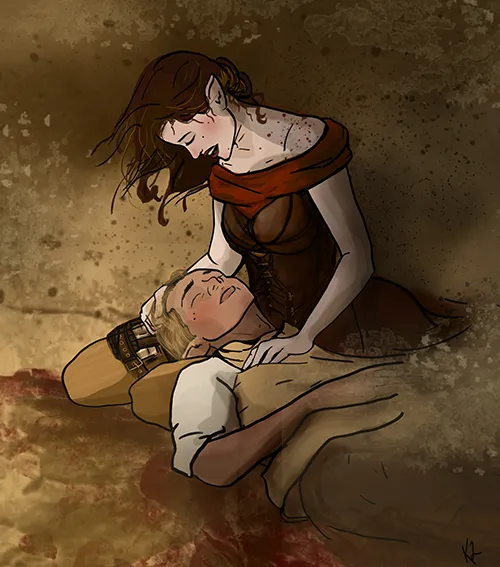 by Kate QuimbyCarter sits with her brother’s head in her lap, pushing his hair from a forehead caked with sand and sweat. The skin of Holland’s cheek is chapped. Even with the deep tan from years in the Kharakhan sun, Carter can see the peeling of a recent burn. The damaged skin flaking away like scales revealing fresh, new skin underneath, flushed the same ruddy pink of Carter’s own cheeks.
He doesn’t look how she remembers. The last time she had seen Holland had been at their father’s service, where they had stood outside in the courtyard, in the blistering midday sun, alongside their father’s bier, following along with the prayers and blessings of the Kindled Flame. For only by the light of the torch were they able to see the path forward, and the best way to serve Isendel. The prayers are automatic, but Carter, then newly twenty, had found comfort in the ritual.
When the Rector had pressed the church flame against their father’s wrappings, and the air filled with white smoke and incense and the faint scent of tobacco and rose, Carter had taken Holland’s hand and she had cried. Their father had been unwell for years, but until this point in the service he’d looked much as he had for the past several weeks. The Baric was in the same position of gentle repose he had often been when Carter would come into his room with the papers of the day. Supported by his pillows, eyes closed but listening closely as Carter summarized the meetings she had attended in his absence, and the letters she had written on his behalf. And in that moment, in the courtyard of the Blackwood Estate, surrounded by the small collection of knights and the expected delegations from other noble families, Carter had held Holland’s hand and wept for their father.
“…and as the Torch lights the way for us all, so shall it illuminate our new Baric Blackwood.” In Carter’s memory, the Rector’s voice is thin and sharp, cutting through the air above the low murmur of mourning.
Holland had pulled his hand away, then. He’d flexed his fingers and wiped his hand on his trousers, as if Carter had left something unsavory with her touch.
Carter remembers feeling the shift, more than seeing it. When Holland had taken that half-step forward, away from her. As if, as the fire spread, Holland seemed subtly taller, growing somehow mythic and resonant with the echoes of generations of the family Blackwood and in that instant, Carter had envisioned the responsibility settling around Holland’s shoulders like a collar, weighing him down. She could see it on his face. In the tightness of his jaw. Holland wasn’t built for this. It was too heavy for him. Carter had studied her brother’s hand, shaking in the firelight, and the flicker of quickly shifting eyes. The small darts of anxiety that had reminded Carter of their father.
In that moment, Carter had felt a wave of pity for her brother. She hadn’t grown up with Holland, really. They were in the same home, but he had always seemed to be so adult, compared to Carter. She competed against his echo - her father praising her intelligence when she surpassed Holland’s scores again and again on tests of literature, of civics and history and horseback riding and sharpshooting and writing elegant Elven script. For much of Carter’s childhood, Holland was a bar to surpass. Those rare times they spoke in person - evening suppers with their father, Holland was usually cold and distant, though after an extra glass of port, he would often become cruel, the conversation spiraling into small, quiet denigrations that cut Carter like shards of glass.
When Holland had been granted the Inquisitorship, though, he had changed. He was rarely at the Estate. Being an Inquisitor meant being willing to protect the borders of Isendel from the worst of her enemies - from the hoards of savages in the North to the witches attacking Isendelian villages at the Morathi border. But Holland had…he had taken to it so well. He would return for a grasp, or a turn, and he would be happy. He and Carter would ride out together, over the grounds, spending afternoons hunting foxes with the better looking of the men-at-arms - Holland teasing Carter about her taste in guards, surprising Carter into laughing. Holland rarely talked about his work. Carter and Holland had spent days talking about her schooling - Holland laughing and insisting on more theology after Carter had admitted to skipping the Rector’s lessons on the seemingly-ever-changing Church of the Kindled Flame - and, eventually, about how best to manage their father’s declining condition.
Holland and Carter hadn’t spoken properly, before their father’s service. Holland had been late, and visibly upset, red-eyed and caked with the dust of the road. He had been far on his most recent assignment - near the Morathi border and grasps away by horseback - and so the service had already been delayed as long as it could be.
And it had gone badly. Carter and Holland had spoken after the service, and it had been as if the Holland Carter had grown to know - and to rather like - had left altogether, and in his place was the vicious bully of her childhood. She needed to stop, he had said. He knew she had been hosting salons and entertaining the sort of politically-minded academics who could also accurately be called anarchists, and the sort of theologians who slipped from speaking of the purely hypothetical into active heresy.
The only positive of the conversation - hidden amongst Holland’s threats - was that he was leaving. When Carter had asked the new location, Holland had laughed.
“Kharakhan,” he had said. “They’re sending me to Kharakhan.” He’d shaken his head, and when he spoke again, his voice was thick. “They’re sending me to Kharakhan alone.”
Carter hadn’t asked Holland to explain. She hadn’t cared who he went to Kharakhan with, as long as he was out of Isendel, and she said as much to Holland, trying for a joke.
“You need to be more careful, little sister,” Holland had said, then. “When I was at the Morathi border, sometimes we would get word of a witch. We’d go to the village, and every now and then, the villagers would try to defend the witch. To protect this…vile heretic out of some fear or misplaced awe. And in those instances it was always a shame, because then we would have to set fire to the town. That all of the smallfolk in the village had to die because one person refused to surrender. Just…awful.” He looked at Carter, eyes narrow, “It’s a good thing Father taught us to always think of the whole community, and not just our own selfish wants.”
Holland had left the next day. It was the last time Carter had seen him.
Now, as Carter brushes her hand through Holland’s hair, as she stops pleading for him to magic himself back to life, she feels…a shift. Carter knows there is no witchcraft to this. It’s the weight of a realization. She had seen it settle on Holland at their father’s funeral. Then, Carter had envisioned it as a collar, but what Carter feels now is nothing so restrictive. This time, Carter imagines a growing, shifting thing settling over her shoulders as flexible as living wood. The responsibility of a house strong, but mutable.
Carter looks down at Holland and takes his hand, folding it over his stomach. She’s still weeping, quietly. Not for the man who’d threatened her at her father’s funeral, certainly, but for the joyful, laughing brother who had visited before - who had grown into himself, and become self-confident and kind…
There is the slam of a door and the mutter of Sylas’ voice. He moves past Carter, arms full of documents and a few wrapped parcels.
Sylas.
Maybe Sylas knew something more. He’d acted as if he’d known Holland, and Holland had believed it. Yes. If anyone knew more, it could only be Sylas.
Because Carter realizes that she didn’t really know her brother at all.
Episode navigation
Back to: