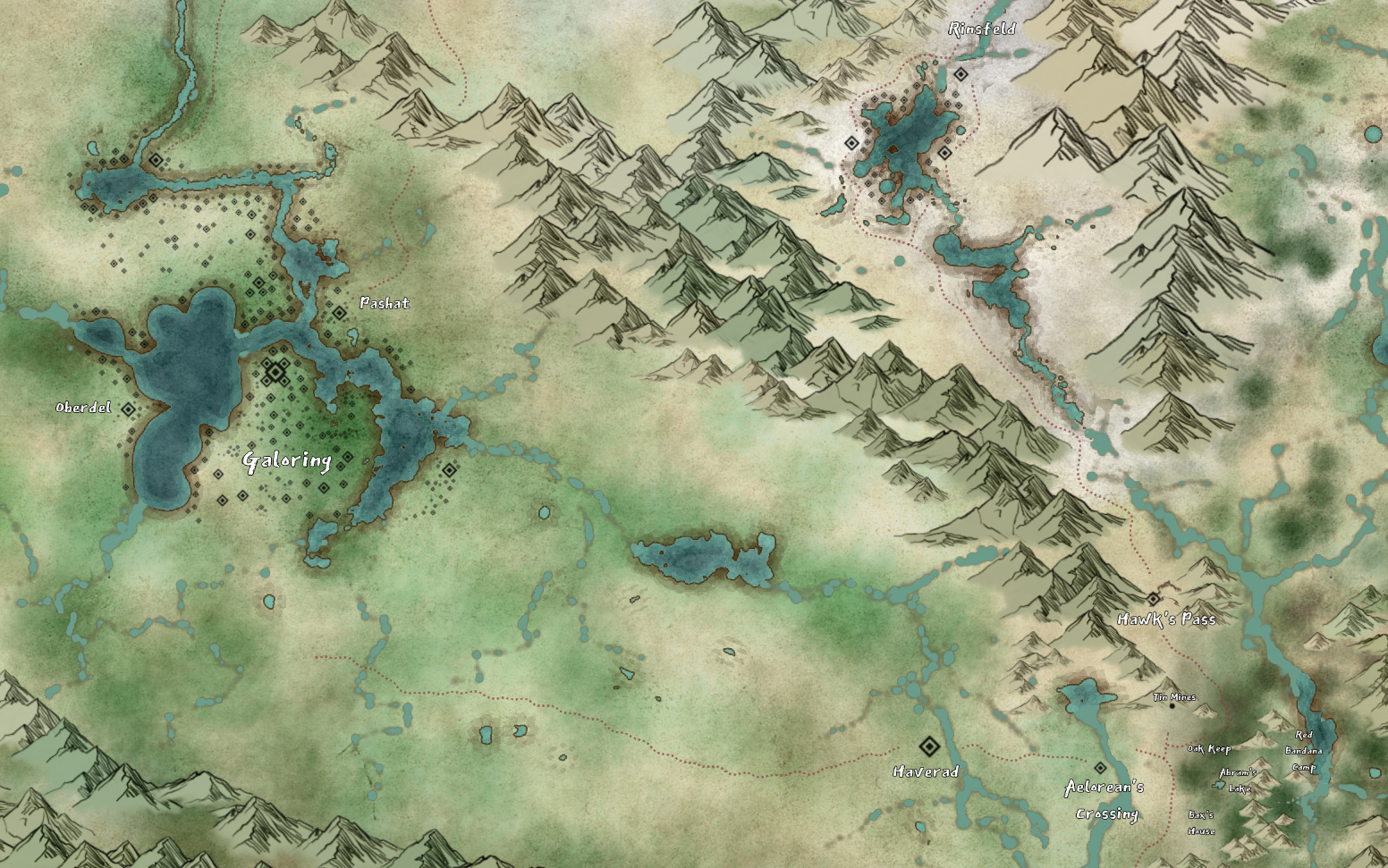
 Showing Galoring, Aelorean's Crossing, and Rinsfeld. By Chris Wong. The barony of Isendel, once a part of the Kingdom of Ithar. In Spring Y212 (Itharian calendar) Baron Hein Isendel died, leaving his daughter Tyr Isendel to ascend to the title. King Aymondane of Ithar died in Y214 and Tyr began to enact her plan of conquest against the other surrounding Baronies. In reaction, a rebellion rose up composed of witches and common folk calling themselves the Briarbirds, and in Y218 the Cathedral in Galoring was invaded and Tyr killed. Mysteriously, her brother, Alistair-Lin Isendel, was rediscovered in her dungeons and took the barony’s title after she was deposed.
In the 9th Era post-Breaking, some apparent 250 years later, little is known of it except that the Barony as a political entity no longer exists, according to Talith Elinasti who had traveled there, but Galoring and Northgate still do.
Locations
Aelorean’s Crossing
Oh no! My beloved peasant village!
Galoring
Capital city of Isendel. Where Sav and Mosrael are from.
Glenhollow
Oh no! My beloved peasant village (Warbler edition)!
Northgate
Where the Witch’s Rebellion against the Swans started.
Last Harbor
A hive of scum and villainy.
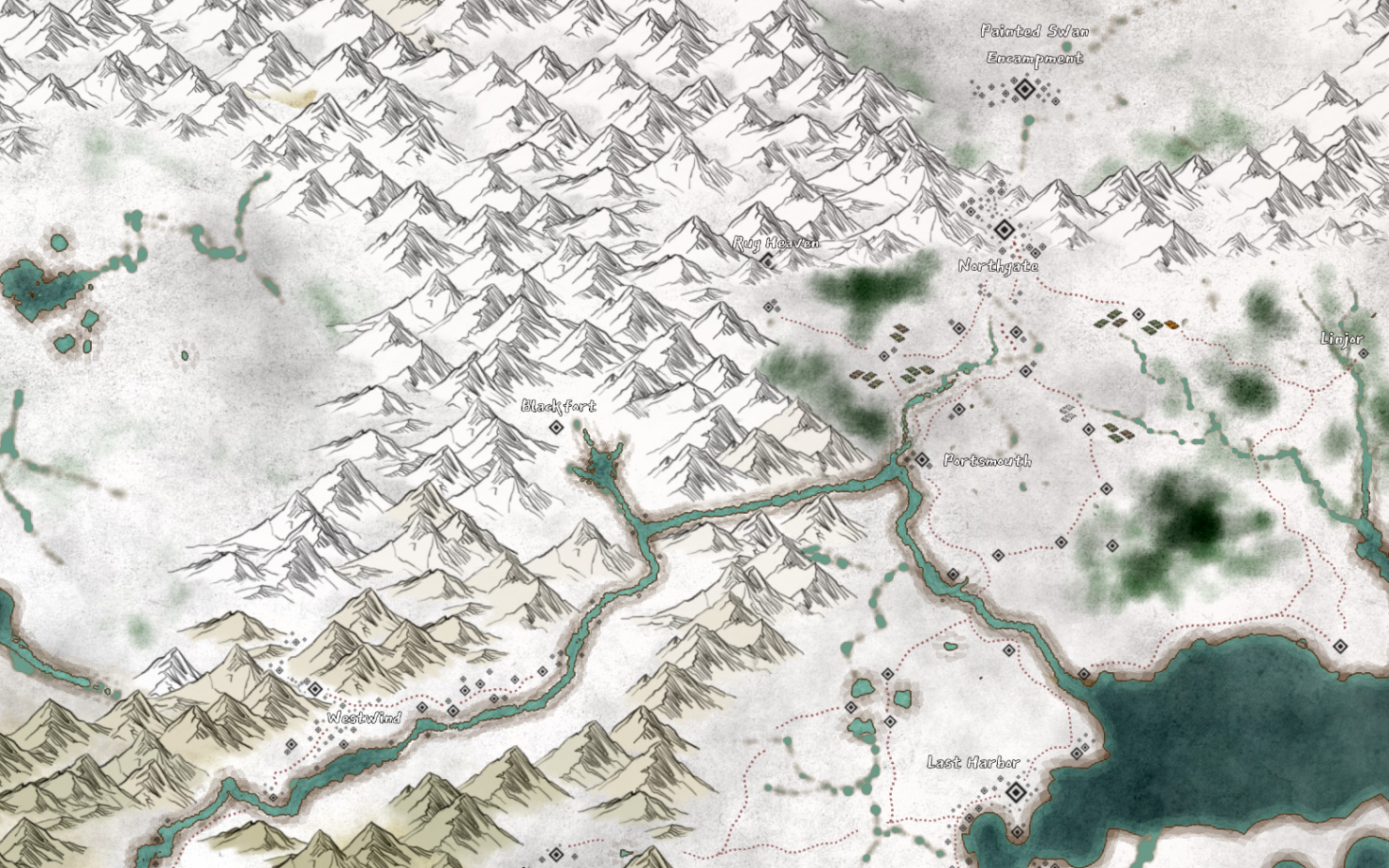 Isendel north (by Chris)
Pashat
A port town where one of the major rivers debouches onto the Lake of the Lost Pearl. Saw a lot of upset by witches and Briarbirds in Y218.
Portsmouth
A river town in the north of Isendel.
Rinsfeld
A town of harsh laws and harsher magistrates.
Rog Hodun
An ancient dwarven city, uncovered by Harvey’s Digsmen. Overrun and depopulated by ice jellies and elementals.
Season 12 - Inquisition Background
The Baron Hein Isendel in the long years of his rule had created a long-sought peace between his barony and the surrounding lands, but despite his great benevolence his life would not be without tragedy — his son and heir Alistair-Lin Isendel killed in an accident along with the young man’s wife and child. It was after this great loss that the baron would look to his younger daughter Tyr to inherit and lead the barony to shape the things to come.
The Survival
It has been revealed that Alistair-Lin Isendel survived the attempt on his life which claimed the life of his wife and his child, which was arranged by Tyr Isendel herself. He joined the Red Bandana Bandits and lives under the alias of Rye, the rogue who trained the children of Aelorean’s Crossing.
The Baroness Tyr Isendel
Her Lord Tyr Isendel is said to be a woman of focused ambition and dedication to the sovereignty of the barony. She ascended the throne in the year 207 and within just a few years had subjugated every rebelling lord within Isendel who refused to recognize her succession. The death of King Aymondane of Ithar signaled the break of what had already been a growing tension and within months of his death the Painted Swans, the army of Isendel, began conquest into the surrounding baronies of Ithar, Moraeth, and Jorung.
Religion and Culture
It is said that the gods which made the world punished the vanity and trespasses of mortals by sundering the land and setting the sky aflame, toppling the once great kingdoms, before abandoning the world to ruin. It was only by casting aside the heretical use of witchcraft and accepting the tenants of the paragons that people were able to rise from the ashes of a ruined land and thrive once again.
The Three Paragons
The fundamental religion of Isendel is adherence to the tenants’ three paragons of virtue — The Hunt, The Harvest, and The Torch. The religion teaches that each contains the elements of both right thought and action as well as an individual’s responsibility within society. The relationship and contradictions between the paragons can be at times nebulous and the interaction between the different aspects has given rise to significant debate among religious scholars. The issue is further complicated by the fact there is no single canonical text, but rather a wide variety of essays and philosophical writings that serve to build the religion’s lexicon and body of thought.
The Baroness is the highest authority of the religious order.
The Hunt speaks to ideas of personal action in the seeking of virtue and suggests that justice and righteousness are found in choices made in personal responsibility to one’s internal self and ideals without need for reward. These ideas speak to the responsibility of the strong to safeguard the weak and too that one must be prepared to face the difficulties of life and bear the burdens of strength.
The Harvest and its ideas deal predominantly within and the responsibility of the individual to the community that surrounds them. The people who live primarily through the tenants of this paragon are often concerned with relationships between their actions and the consequences both apparent and far removed. These ideas also speak to concepts of personal and preparation for the future in addition to the importance of practiced behavior and ritual.
The Torch is concerned with the importance of tradition and perseverance for the preservation of knowledge and righteousness itself, speaking to ideals of justice and stewardship against the loss of righteous thought and behaviors necessary for the good of both the individual and society. These suggest the encroachment of both ignorance and corruption and the responsibility of the individual to preserve knowledge and societal tradition.
The Church of the Kindled Flame represents the sect of Isendelian religion called The Torch and plays a significant role in the governorship of the barony. The arm of agency of the church is the Inquisition, which is led by the Grand Inquisitor — both have become increasingly powerful and involved in the governance of the barony since the establishment of Tyr Isendel as Baroness. Though they are members of the aristocracy, the Inquisition is seldom involved in matters of the military, but is more often concerned with clandestine pursuit of heresy, witchcraft, and treason within the realm.
Developments
The Grand Inquisitor was slain by a conspiracy of witches in Winter 217.
It has been revealed that the Inquisition, under command of Baroness Tyr Isendel, has for years been working to understand and control witchcraft within the Barony rather than eliminate it and has imbued its most most loyal and experienced agents with False Constellations, which imperfectly mimic the magic of the constellations granted by Danica Thorne.
Aristocracy
The land within the Barony of Isendel is granted by the Baron(ess) to a variety of Barics with their lands being granted to a variety of Knights and Lords, each swearing fealty to their noble superiors and those whom those nobles themselves serve with the Baron(ess) serving as the highest noble rank and head of the Church, beneath only the King or Queen of the Realm.
The feudal peerage of Isendel operates parallel alongside the military structure of the standing army, The Painted Swan. The noble ranks of Knight and Lord are peers, but while lordship is inherited by blood, typically in relationship to influence, the rank of Knight is granted by a Baric of the Baron(ess) as merit for deeds of battle. It is not uncommon for the children of a lord not directly in line to inherit lands to be trained and granted knighthood by the Baric to which their family is sworn.
While the nobility are officially peers within their own rank, it is commonly understood one can estimate the favor and hierarchy among Barics, Knights, and Lords is designated by how many seats they are removed from their superior during the assembly of noble court — with a particular noble being introduced as Lord Smithe, Three Chairs of Baric Olgenthor, as an example.
The granted title of knighthood holds approximately the same authority as a Captain within the Painted Swan Army for purposes of cooperation when militia and armies are allied. While the right of nobility can be granted by the Baron(ess) to name an individual a Baric or Lord, it was common during the reign of King Aymondane for the granting of noble title to require the blessing of the King.